
Miguel Indurain rose from Navarre to become one of cycling’s dominant riders, winning five consecutive Tour de France titles from 1991 to 1995. The profile follows his development, showing how his size, time-trial strength and calm race control shaped a career that also included two Giro d’Italia wins, a world title and an Hour Record.
It also covers his 1996 Olympic road time-trial gold and his quiet retirement in 1997. The article presents his legacy as a champion who won through patience, power and consistency rather than constant attacking or public drama.
Miguel Indurain did not need to shout, attack at every opportunity or turn the Tour de France into a personal drama. He simply rode away from the world’s strongest cyclists when the road and the clock demanded it.
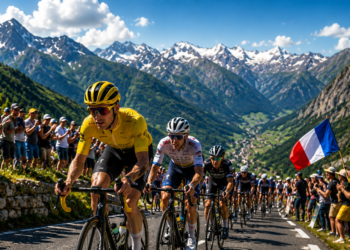
His expression rarely changed. His shoulders remained still while the pedals turned beneath a frame that looked unusually large for a Grand Tour champion. Rivals attacked in the mountains, crowds roared from the roadside, and commentators searched for signs of weakness. Indurain usually answered in the same way: calmly, patiently and with devastating power.
Between 1991 and 1995, the Spaniard won the Tour de France five years in succession. Jacques Anquetil, Eddy Merckx and Bernard Hinault had already reached five victories, but none had claimed them consecutively. Nobody has matched Indurain’s sequence since.
He also won the Giro d’Italia twice, became a world time-trial champion, broke the Hour Record and ended his career as an Olympic champion. Yet the statistics only tell part of the story.
Indurain’s greatness rested on control. He rarely wasted energy, words or emotion. While other champions tried to overwhelm the race through aggression, he made the Tour feel inevitable.
This Miguel Indurain profile traces his development from a promising young rider in Navarre to the quiet giant who ruled July.
For more stories about the figures who shaped sport, visit the World in Sport sports icons hub.
The latest races, results and features can also be found in our cycling coverage.
Miguel Indurain career overview
| Career detail | Miguel Indurain record |
|---|---|
| Full name | Miguel Indurain Larraya |
| Date of birth | 16 July 1964 |
| Place of birth | Villava, Navarre, Spain |
| Nickname | Big Mig or Miguelón |
| Professional career | 1984–1996 |
| Professional teams | Reynolds, Banesto |
| Grand Tour appearances | 23 |
| Grand Tour victories | Seven |
| Tour de France victories | Five |
| Giro d’Italia victories | Two |
| Grand Tour stage victories | 16 |
| Olympic titles | One |
| World time-trial titles | One |
| Tour yellow-jersey days | 60 |
| Hour Record | 53.040km in 1994 |
Indurain started 23 Grand Tours during his career: 12 Tours de France, 8 editions of the Vuelta a España, and 3 Giros d’Italia.
He finished 17 of them and won seven. His five Tour victories and two Giro titles came during a remarkable five-season period in which he became almost untouchable over three weeks.
Villava gives Indurain his first road
Indurain was born in Villava, a town near Pamplona in the northern Spanish region of Navarre. He grew up in a farming family and experimented with several sports before cycling became the centre of his life.
His first bicycle was reportedly a second-hand machine given to him as a child. After it was stolen, he worked with his father to help pay for a replacement. That story suited the personality the cycling world later came to recognise: quiet, practical and prepared to work without complaint.
Indurain joined the local Club Ciclista Villavés and quickly developed from an enthusiastic youngster into one of Spain’s most promising amateur riders. He was not built like a typical climber. At around 1.86 metres tall, he carried more physical mass than many of the slight mountain specialists who traditionally dominated stage racing.
However, his size came with an extraordinary cardiovascular engine. He could maintain a huge pace on flat roads and long climbs without appearing to move his upper body. Once coaches understood how effectively he could convert that power into sustained speed, his potential became obvious.
At 18, Indurain became the youngest winner of the Spanish amateur road championship. He represented Spain at the 1984 Olympic Games in Los Angeles before joining the Reynolds professional team later that year.
The future Tour winner did not arrive as a finished champion. He arrived as a long-term project.
Reynolds lets a Tour champion develop
Modern cycling often expects talented riders to challenge for major races almost immediately. Indurain’s development followed a slower path.
He turned professional in September 1984 and won a time trial at the Tour de l’Avenir shortly afterwards. The result offered an early glimpse of the discipline that would define his career, but his first Grand Tour appearances exposed how much he still needed to learn.
Indurain made his Vuelta a España debut in 1985. After finishing second in the opening prologue, he briefly became the youngest rider to lead the race. He later finished 84th overall.
His first Tour de France followed that summer, but he abandoned during Stage 4. He returned in 1986 and again failed to reach Paris, leaving the race during Stage 12.
There was no immediate sign that cycling had found its next five-time champion. Indurain had the physical capacity, but he still needed to improve his endurance, climbing, positioning and understanding of a three-week race.
Reynolds gave him that time.
Indurain completed his first Tour in 1987, finishing 97th. He improved to 47th in 1988 while working for Pedro Delgado, who won the yellow jersey for Reynolds.
That supporting role mattered. Delgado was one of the finest stage racers of his generation, and Indurain learned how a Tour leader survived pressure, used teammates and controlled his effort across three demanding weeks.
He was still a domestique, but the apprentice was becoming strong enough to win on his own.
Delgado’s lieutenant becomes a Tour threat
Indurain’s first Tour de France stage victory arrived in 1989 on the road to Cauterets.
It was an important breakthrough because it challenged the idea that he was only a time-trial specialist. Indurain could climb with elite riders and finish a mountain stage, even if his large frame made him look out of place among the lighter specialists.
He finished 17th overall that year and continued to ride in support of Delgado. However, the balance within the team was beginning to change.
In 1990, Indurain won Paris–Nice for the second consecutive year and claimed the Clásica de San Sebastián, proving he could succeed in both stage races and a demanding one-day Classic.
His Tour performance provided the clearest evidence of his transformation. Indurain won the mountain stage to Luz Ardiden and finished 10th overall, despite sacrificing time while working for Delgado.
By the end of the season, Banesto — the successor to Reynolds — had two potential Tour leaders. Delgado remained the established champion, but Indurain was younger, stronger against the clock and still improving.
The 1991 Tour would settle the question.
The 1991 Tour starts a five-year reign
Greg LeMond began the 1991 Tour de France seeking a fourth victory. Gianni Bugno, Claudio Chiappucci and Delgado also carried genuine hopes of winning the race.
Indurain was respected, particularly as a time-trialist, but he was not yet regarded as the man the entire Tour had to beat.
That changed during the Stage 8 time trial to Alençon. Indurain won the stage and moved into contention without overextending himself during the opening week.
The decisive move came in the Pyrenees on the road to Val Louron.
Indurain attacked over the Col d’Aspin and eventually joined Chiappucci at the front. The pair drove onwards while LeMond and several other rivals struggled behind. Chiappucci won the stage, but Indurain took the yellow jersey.
Once he gained control, he refused to release it.
He won the Tour by three minutes and 36 seconds from Bugno, with Chiappucci third. It was the first Spanish Tour victory since Delgado in 1988, but its wider significance only became clear over the years that followed.
The yellow jersey had found its new owner.
Indurain turns time trials into a weapon
Indurain’s Tour strategy was easy to describe and almost impossible to stop.
He would minimise danger during the flat stages, stay close enough to the leading climbers in the mountains and then destroy the field in the long individual time trials.
His technique looked simple. He found an aerodynamic position, selected a huge gear and held a punishing pace that few rivals could match. There was no wheel to follow and no teammate to provide protection. The clock revealed the difference.
That made Indurain’s Tour victories feel different from the attacking triumphs of Merckx or Hinault. He rarely chased stage wins he did not need. During his five-year reign, all of his individual Tour stage victories came in time trials.
The approach sometimes drew criticism. Supporters of aggressive racing wanted their champion to attack more often in the mountains. Indurain saw no reason to provide unnecessary entertainment if it placed the yellow jersey at risk.
He did not ride to create chaos. He rode to win the Tour.
The comparison with previous champions remains fascinating.
Eddy Merckx’s entire career was built on an appetite for winning almost everything, while Bernard Hinault’s uncompromising style often forced races into open conflict.
Indurain reached the same total of five Tour victories through patience, calculation and control.
The Giro-Tour doubles widen his dominance
Winning the Tour de France once proved Indurain belonged among the elite. His 1992 season showed he could dominate far beyond July.
He entered the Giro d’Italia and took control through the time trials, becoming the first Spanish rider to win the Italian Grand Tour. Indurain defeated Chiappucci by more than five minutes before turning his attention towards France.
At the Tour, one performance captured the scale of his power.
During the long time trial to Luxembourg, Indurain rode through the field at an extraordinary speed. He caught Laurent Fignon on the road despite the former Tour winner starting several minutes ahead of him.
The sight of the enormous Spaniard passing a double Tour champion became one of the defining images of his career. Indurain was not merely faster than his rivals. On his best days, he appeared to be competing in a different race.
Chiappucci produced a famous long-range attack to win at Sestriere, forcing Indurain to chase through the Alps. Yet even one of the boldest mountain performances in Tour history could not break him.
Indurain secured his second yellow jersey before returning in 1993 to repeat the Giro–Tour double.
The Giro d’Italia Hall of Fame recognises his back-to-back victories in 1992 and 1993. No rider since Indurain has won consecutive editions of both the Giro and Tour in the same two seasons.
The second double required both resilience and power. Tony Rominger emerged as a serious challenger during the 1993 Tour, but lost time during the team time trial before Indurain took control in the individual test at Lac de Madine.
Rominger fought back in the mountains and won the final time trial. Indurain nevertheless reached Paris with his third consecutive yellow jersey.
By then, his dominance had moved beyond tactics. Rivals knew they needed to gain significant time before the major individual tests. That pressure encouraged attacks, but it also led riders to take risks and spend energy that Indurain was happy to conserve.
Five Tours make history
Indurain began the 1994 season chasing a fourth Tour victory, although his attempt at a third Giro–Tour double ended when Evgeni Berzin defeated him at the Giro. Indurain still finished third, maintaining his perfect finishing record in the Italian race.
At the Tour, he produced another defining time-trial performance on the road to Bergerac. He covered the course with such speed that the general classification was effectively reshaped in a single afternoon.
Indurain defended his lead through the mountains and won his fourth consecutive Tour ahead of Piotr Ugrumov.
Later that year, he turned his attention to the track. Riding the futuristic Pinarello Espada in Bordeaux, Indurain covered 53.040km in one hour. It was a new Hour Record under the regulations of the time, although Tony Rominger surpassed it weeks later. Subsequent UCI rule changes altered how records from the aerodynamic era were classified.
Indurain’s fifth Tour in 1995 was more aggressive.
He attacked during the road stage to Liège and then dominated the time trial at Lac de Vassivière. Alex Zülle and Bjarne Riis completed the podium, but neither could stop Indurain from reaching Paris in yellow again.
The victory placed him alongside Anquetil, Merckx and Hinault as a five-time Tour champion. Crucially, Indurain had won all five in consecutive seasons.
His five victories came against changing sets of challengers. LeMond, Bugno, Chiappucci, Rominger, Berzin, Ugrumov, Zülle, Riis and Marco Pantani all tried to disrupt his control.
None succeeded between 1991 and 1995.
| Year | Tour runner-up | Defining moment |
|---|---|---|
| 1991 | Gianni Bugno | Indurain takes yellow after the Val Louron mountain stage |
| 1992 | Claudio Chiappucci | Dominant Luxembourg time trial establishes his authority |
| 1993 | Tony Rominger | Lac de Madine time trial gives Indurain control |
| 1994 | Piotr Ugrumov | Bergerac time trial breaks the opposition |
| 1995 | Alex Zülle | Liège attack and Lac de Vassivière victory secure history |
The 1996 Tour finally breaks the spell
Indurain entered the 1996 Tour attempting to achieve something no male rider had done: win the race six times.
For the first time in years, his body did not respond when the decisive pressure arrived.
He lost more than four minutes on the climb to Les Arcs and suffered again in the Pyrenees. The route even passed through his home region of Navarre, where thousands gathered, expecting to see their champion launch a recovery.
There was no comeback.
Riis won the Tour, with Jan Ullrich finishing second. Indurain reached Paris in 11th place, ending a run of five consecutive victories without offering excuses or blaming his team.
The result made his previous consistency look even more remarkable. Indurain had not simply won five Tours. He had survived every crash, difficult day, tactical trap and physical test required to remain champion for half a decade.
His Tour record reads like the gradual construction and sudden ending of a dynasty.
| Grand Tour | Appearances | Finishes | Overall victories | Stage victories | Best other result |
|---|---|---|---|---|---|
| Tour de France | 12 | 10 | Five | 12 | 10th in 1990 |
| Giro d’Italia | Three | Three | Two | Four | Third in 1994 |
| Vuelta a España | Eight | Four | None | None | Second in 1991 |
| Total | 23 | 17 | Seven | 16 | Seven Grand Tour podium finishes |
Atlanta provides the perfect final victory
The Tour defeat did not end Indurain’s season or his career immediately.
Weeks later, he represented Spain at the Atlanta Olympic Games. The 1996 programme included the first Olympic men’s individual road time trial, giving Indurain one last opportunity in the discipline he had mastered.
He defeated fellow Spaniard Abraham Olano to win gold.
The official Olympic profile for Miguel Indurain records a victory that provided a fitting conclusion to his time at the highest level. After years of measuring himself against the clock, Indurain became the first Olympic champion in the event.
He later started the Vuelta a España but abandoned before the finish. Offers to continue racing remained available, including the possibility of changing teams, but Indurain decided he had achieved enough.
He announced his retirement on 1 January 1997.
There was no prolonged farewell season and no attempt to reclaim the Tour. Indurain left quietly, much as he had raced.
Indurain’s records and major achievements
| Achievement | Miguel Indurain record |
|---|---|
| Tour de France | Winner in 1991, 1992, 1993, 1994 and 1995 |
| Consecutive Tour victories | Five, an unmatched record |
| Giro d’Italia | Winner in 1992 and 1993 |
| Giro–Tour doubles | Two, achieved in consecutive seasons |
| Tour stage victories | 12 |
| Tour yellow-jersey days | 60 |
| Olympic Games | Individual time-trial gold in 1996 |
| World Championships | Individual time-trial gold in 1995 |
| World road race | Silver in 1993 and 1995 |
| Hour Record | 53.040km in 1994 |
| Paris–Nice | Winner in 1989 and 1990 |
| Volta a Catalunya | Winner in 1988, 1991 and 1992 |
| Critérium du Dauphiné | Winner in 1995 and 1996 |
| Clásica de San Sebastián | Winner in 1990 |
| Spanish road championship | Winner in 1992 |
Reliable totals for Indurain’s career salary and prize earnings are not publicly itemised. He raced before modern financial reporting made rider contracts more visible, while many contemporary figures were reported in Spanish pesetas.
Assigning a precise modern value in pounds and dollars would therefore create a misleading impression of accuracy.
Why Indurain’s style divided opinion
Not every fan loved the way Indurain won.
His time-trial superiority could create substantial gaps before the most famous mountain stages. Once ahead, he usually followed attacks rather than launching unnecessary moves of his own. Rivals could win stages, but Indurain protected the yellow jersey.
To some viewers, that approach removed unpredictability. The result often looked settled while several days of racing remained.
However, describing Indurain as a defensive rider may underestimate the demands of his strategy.
He still had to remain with the best climbers in the Alps and Pyrenees. He needed to avoid crashes in nervous opening stages, survive crosswinds, manage recovery and produce enormous power after two weeks of racing.
There was nothing passive about riding a long Tour time trial several minutes faster than world-class opponents.
Indurain understood where he held the greatest advantage and built his race around it. That was not a lack of ambition. It was tactical clarity.
Modern Tours contain fewer time-trial kilometres than many editions from Indurain’s era, placing greater emphasis on repeated mountain attacks.
Our Tour de France route guide shows how varied the modern race has become.
Yet a champion can only master the race set before him. Indurain mastered his five times without interruption.
The quiet personality becomes part of the legend
Indurain’s personality made him an unusual superstar.
He rarely criticised rivals in public and did not attempt to dominate press conferences. While other champions created headlines through confrontation, Indurain answered questions carefully and returned to his team.
His nickname, Big Mig, referred to his physical size, but there was little of the intimidating showman in his public behaviour.
Teammates described a leader who remained calm and treated support riders with respect. He understood that controlling a Grand Tour required the work of an entire team, from mountain domestiques and road captains to mechanics, soigneurs and directors.
That humility strengthened his popularity in Spain.
Indurain became a national sporting hero without behaving like a celebrity. The people of Navarre saw somebody whose success had not separated him from his roots.
After retirement, he remained involved in cycling and sporting initiatives but largely avoided the constant pursuit of publicity. Events and organisations carrying his name have helped promote participation in his home region, while he continues to appear at major cycling occasions.
Miguel Indurain’s legacy
Indurain’s place in cycling history begins with five consecutive Tours, but it should not end there.
He was the first Spanish winner of the Giro d’Italia and won it twice. He completed consecutive Giro–Tour doubles, became a world champion, set an Hour Record and finished his career with Olympic gold.
Most importantly, he created a style of dominance that was entirely his own.
Merckx attacked because winning was never enough. Hinault raced as though every challenge were personal. Indurain reduced Grand Tours to a series of problems and solved each one without panic.
He knew when to follow, when to wait and when to use the time trial to remove doubt.
That composure made his victories appear easier than they were. Rivals such as Chiappucci, Rominger and Pantani brought emotion and attacking instinct to the road. Indurain absorbed the pressure and continued at his own pace.
Every July between 1991 and 1995 ended the same way. The rivals changed, the routes changed, and the challenges changed, but the quiet man from Villava reached Paris in yellow.
Miguel Indurain did not rule the Tour through noise or intimidation.
He ruled it through power, patience and an almost complete absence of fear.