Formula 1’s 2026 rule reset changes the power unit, aerodynamics, car size, safety standards and qualifying format. The article explains how smaller, lighter cars with more electric power, active aero and sustainable fuel are intended to improve racing and make the sport more relevant to manufacturers.
It also outlines the end of the MGU-H, the introduction of Overtake Mode, and the effects of a 22-car grid on qualifying. The overall shift is from a DRS-led era to one centred on energy management, efficiency and driver decision-making.
Formula 1 has entered one of its biggest rule resets in years. The F1 2026 rule changes affect almost every part of the sport, from the engines and fuel to the cars’ shapes, the way drivers overtake, and even how qualifying works.
For fans, the headline is simple. The cars are smaller, lighter and more efficient. The engines still use a 1.6-litre turbo hybrid V6, but the hybrid side now does far more work. The old DRS-style era has changed, too. Drivers now manage active aerodynamics, battery deployment and Overtake Mode.
That sounds technical, but the idea behind the rules is easy to follow. Formula 1 wants closer racing, more driver input, greater relevance to road cars for car makers, and a stronger link to sustainable fuel technology.
This guide explains the basics without going too deep into engineering. It is a pillar-style article for fans who want to understand what changed, why it matters, and how the 2026 season may feel different.
For the wider picture, start with our complete F1 2026 season guide, then follow the latest updates through our Formula 1 news hub and wider motorsport news.
What are the F1 2026 rule changes?
The F1 2026 rule changes are a full package of new technical, sporting and financial rules. They are not just a small update to the previous cars.
The main changes cover the power unit, fuel, chassis size, aerodynamics, overtaking tools, safety tests, qualifying format and team spending limits.
The most important point is that the engine and the car had to change together. A new power unit needs a new chassis idea. So F1 did both at once.
Why did F1 change the rules for 2026?
F1 changed the rules because the sport needed a new direction after the first turbo hybrid era.
The previous power units were fast and efficient. However, they were also complex. The MGU-H, which recovered energy from exhaust gases, was clever but costly and difficult to integrate with standard road-car technology.
Formula 1 wanted more manufacturers to join. To do that, it needed a simpler and more relevant engine package.
The 2026 rules also aim to fix another issue. Modern F1 cars have become very large and heavy. They were still quick, but they looked less nimble than older cars. They also created dirty air, which made it difficult to follow another car at some circuits.
So the FIA and Formula 1 moved towards a more agile car concept. The cars are smaller. The tyres are narrower. The minimum weight is lower. The aero package is also cleaner, with less dependence on the old ground-effect floor tunnels.
The goal is not to make F1 slower for no reason. The goal is to make the cars race better.
New F1 2026 engines explained
The 2026 F1 power unit is still based around a 1.6-litre turbocharged V6 engine. That part may sound familiar. However, the way power is generated and used has changed significantly.
The old hybrid system used two motor-generator units. The MGU-K recovered energy from braking. The MGU-H recovered energy from the turbo system’s heat.
From 2026, the MGU-H is gone.
That makes the engine simpler. It also helps new manufacturers enter the sport because the MGU-H was one of the hardest and most expensive parts of the old rules.
The MGU-K now does much more work. Its output rises from 120kW to 350kW. In plain English, that means the electric side of the car is far more powerful than before.
Formula 1 says the split between combustion power and electric power is now much closer to 50/50. That is a major shift. Drivers no longer just manage tyres, brakes and fuel. They also have to think more about battery charge, energy recovery and when to deploy power during a battle.
You can read the official overview in Formula 1’s 2026 regulations guide.
What happened to the MGU-H?
The MGU-H has been removed for 2026.
That is one of the biggest engine changes. The MGU-H was a smart part of the hybrid system, but it was also expensive and complex. It did not have the same clear road car link as the MGU-K.
Removing it helps F1 in three ways.
First, it makes the power unit easier to explain. Second, it makes the engine rules more attractive to manufacturers. Third, it places greater focus on braking energy, battery use, and driver decision-making.
The trade-off is that teams have had to rethink how they keep the turbo efficient and how they manage energy across a full lap.
That is why some teams may rise or fall quickly under the new rules. A strong engine partner could be a huge advantage in the first year of the new era.
F1 2026 sustainable fuel: what does it mean?
The 2026 cars run on advanced sustainable fuel. This is a key part of Formula 1’s long-term plan to reach net zero carbon by 2030.
The fuel is designed as a drop-in fuel. That means it can work in an internal combustion engine without needing a totally new engine concept. F1 sees this as important because millions of petrol and diesel vehicles will still exist around the world for years.
This does not make a Grand Prix weekend carbon-free. F1 still has major travel and logistics challenges. However, the fuel change matters because it gives the sport a clear test bed for cleaner combustion technology.
For fans, the main point is this: F1 has not abandoned engine noise, speed or combustion. Instead, it has tried to combine combustion with much stronger electric power and cleaner fuel.
Active aero explained
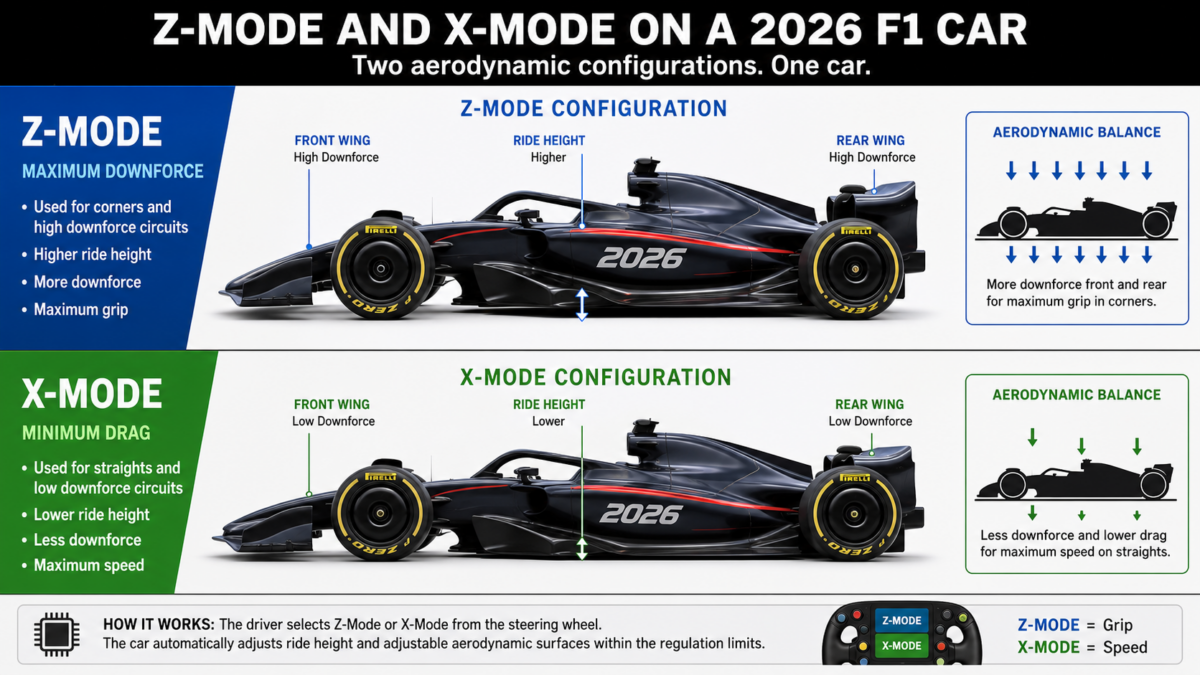
One of the biggest visual and racing changes is active aerodynamics.
Before 2026, fans knew DRS. A chasing driver could open part of the rear wing when within one second of the car ahead in a DRS zone. It reduced the car’s drag and increased its straight-line speed.
The 2026 system is broader. Both the front and rear wings can move. The car can switch between a higher-downforce setup for corners and a lower-drag setup for straights.
This creates two basic modes.
This is not just DRS with a new name. The old DRS was mainly for the car behind. Active aero is part of the normal car concept and is available to drivers in the correct zones.
That should make the cars more efficient. It should also make battles less simple, because the driver’s battery and boost choices now matter more.
What is Overtake Mode in F1 2026?
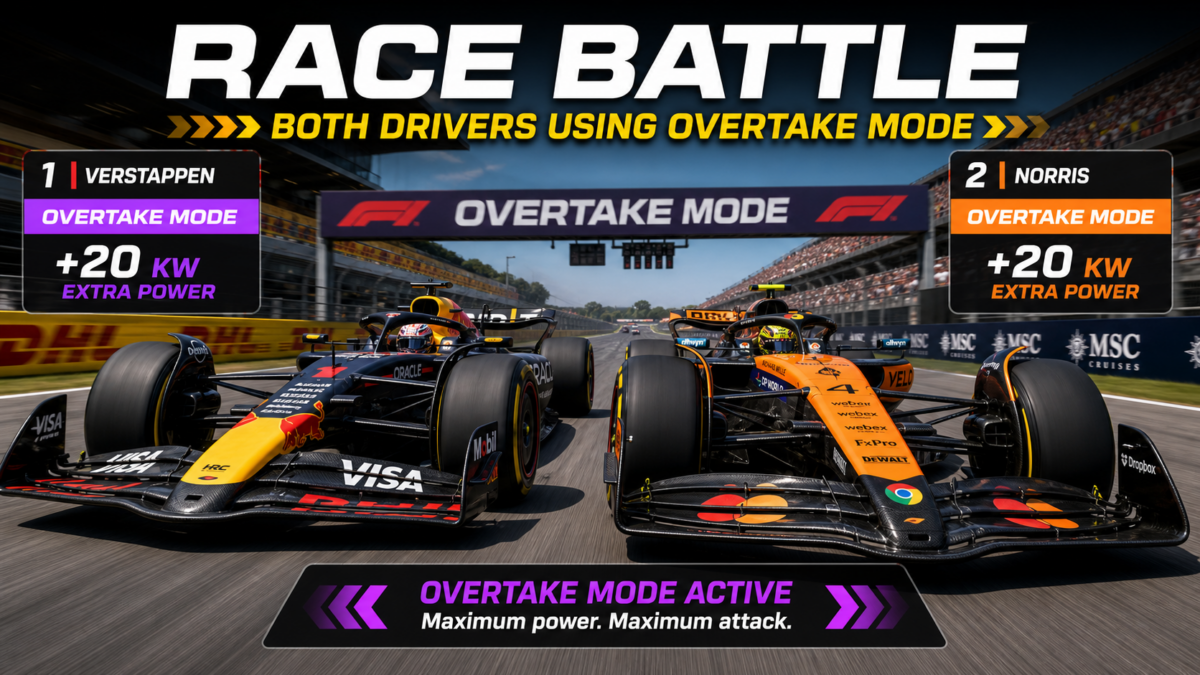
Overtake Mode is the new attacking tool.
Under the 2026 rules, a driver can receive extra electrical support if they are close enough to the car ahead at a set detection point. The idea is to help the attacking car sustain a higher speed for longer.
This does not work exactly like old DRS. It is more about electrical power than just opening a rear wing. The attacking car can use extra energy to help create a passing chance.
It also gives drivers another option for managing. Should they use the extra power early? Should they save it for later in the lap? Can they force the driver ahead to defend and drain their own battery?
This should add a new layer of strategy. It may also create more varied overtaking, instead of moves happening in the same DRS zone every lap.
Smaller and lighter F1 cars
The 2026 cars are smaller than the previous generation.
The maximum wheelbase is shorter. The car is narrower. The tyres are also slimmer, with the front tyres reduced by 25mm and the rear tyres reduced by 30mm. The minimum weight has also dropped from 800kg to 768kg.
That matters because F1 cars had grown very large. At tight tracks, drivers often complained that the cars were too big to fight cleanly. A smaller car should give drivers more room to race.
A lighter car should also feel sharper. It should change direction more smoothly and feel lighter in slow corners.
However, lighter does not mean easier. Teams still have to hit the minimum weight, and that is never simple. New safety structures, batteries and hybrid parts all add weight. As a result, weight saving remains one of the big design battles.
Why are the tyres narrower?
The 2026 cars still use 18-inch wheels, but the tyres are narrower.
Narrower tyres help reduce drag and weight. They also align with the broader aim of creating smaller, more efficient cars.
The downside is simple. A smaller tyre contact patch can mean less mechanical grip. That puts more pressure on aero balance, suspension design and driver feel.
For fans, this could make the cars more lively. Drivers may have to work harder to manage slides, traction and tyre temperature.
That is not a bad thing. In fact, it may bring more of the driver’s skills back into view.
New aerodynamics and less ground effect
The 2022 rules brought back ground effect in a major way. Cars generated huge downforce from the floor, using tunnels underneath the car.
For 2026, that approach has been reduced. The cars use a different floor concept and a lower-powered diffuser. The aim is to reduce the heavy reliance on floor-generated downforce and cut the dirty air that makes following hard.
The front wing is also narrower. The rear wing has changed, too. The lower beam wing has gone, and the endplates have been simplified.
This matters because F1 always has a battle between speed and racing quality. Maximum downforce can make cars fast, but it can also make them hard to follow. The 2026 rules try to find a better balance.
For deeper technical updates through the season, follow our Formula 1 news hub.
Safety changes in the 2026 F1 rules
F1 has reduced car weight, but it has not reduced safety standards.
The 2026 rules include stronger crash tests and revised front impact rules. The nose structure now uses a two-stage design, which is intended to provide additional protection if a car experiences a second impact after the first.
The roll hoop test is tougher, too. Side intrusion protection has also been improved.
This is important because lighter cars can raise questions about safety. In this case, the FIA has sought to make the cars lighter and stronger simultaneously.
Fans may also notice brighter rear-wing lights and additional safety lighting systems. These are small details, but they can help in wet races, recovery situations and energy-related stoppages.
The FIA has outlined the wider rules on its future-focused 2026 Formula 1 regulations page.
Qualifying changes with 22 cars on the grid
Cadillac’s arrival means F1 has 11 teams and 22 cars.
That changes qualifying. The basic three-part format stays the same, but more cars are knocked out in the first two parts.
This keeps Q3 as the same 10-car shootout. However, Q1 becomes more dangerous for midfield teams because one extra car drops out.
That could make early qualifying more tense, especially on short tracks where traffic is a major problem.
What do the rules mean for racing?
The 2026 rules should change how races feel.
Drivers have more to manage. They need to think about tyre life, battery charge, boost, Overtake Mode and active aero. They also need to adapt to cars with less downforce and narrower tyres.
That should reward the best all-round drivers. Smooth energy use could matter as much as raw pace. A driver who attacks too early may run out of battery. A driver who saves too much may miss the chance to pass.
Strategy teams also have more to solve. Race engineers must help drivers balance energy recovery, overtaking and defence. This could make radio messages more important during battles.
However, not every race will be transformed overnight. F1 teams are clever. They will quickly find performance. As the rules mature, the field may spread out before it closes again.
Which teams could benefit most?
New rules often reset the field.
Teams with strong engine programmes could gain an early advantage. So could teams that understand active aero faster than others.
The best package will not just be the most powerful engine or the most slippery car. It will be the car that most effectively blends engine, battery, aero, tyres, and cooling.
The new power unit era has also attracted and reshaped manufacturers. Mercedes and Ferrari remain central. Honda has a major works role with Aston Martin. Audi enters as a works team after taking over Sauber. Red Bull Powertrains works with Ford.
That makes 2026 a major manufacturer battle, not just a chassis battle.
For a wider team and business context, see our F1 prize money guide and F1 2026 season guide.
How much does the 2026 F1 cost cap change?
The 2026 cost cap has risen to around £170m ($215m) for the main team cap.
At first, that looks like a huge spending jump. However, it does not mean teams can spend far more without limits. More costs are now included within the cap, and the new rules required major design work.
In simple terms, F1 has changed what sits inside the cap. The headline number is bigger, but the structure has also changed.
That matters because 2026 is expensive. Teams needed new cars, new parts, new tools and new development paths. A cost cap that was too tight could have punished teams during a full reset of the rules.
The bigger cap also reflects the wider scope of the rules. It gives teams room to operate while maintaining spending control.
Are the 2026 F1 cars slower?
The 2026 cars may be slower in some areas, especially early in the rules cycle. They have less downforce and narrower tyres, so cornering speeds may change at some circuits.
However, that does not mean the cars are slow. They still have huge power, advanced hybrid systems and active aero. They will also develop quickly as teams learn.
The better question is not whether the cars are slower by a few tenths. The better question is whether the racing improves.
If cars can follow more closely, use energy in different ways, and fight without relying on a single DRS move, the rules will have done their job.
What fans should watch in 2026
The key thing to watch is energy use.
In the past, fans often focused on tyre wear and DRS zones. Those still matter in different ways, but 2026 adds more visible energy management.
Watch when a driver attacks. Watch whether they have saved enough battery. Watch if they can stay close enough at the detection point. Watch how often they use Overtake Mode and whether the defending car has enough energy to respond.
Also, watch the cars in corners. Lower downforce and narrower tyres may make them move around more. That can show which drivers have confidence and which cars are hard to control.
Finally, watch development. The first race of a new rules era rarely tells the whole story. Teams can improve quickly, and a single upgrade package can change the order.
F1 2026 rule changes: quick summary
The F1 2026 rule changes are about more than a new look. They reshape how the cars make power, how drivers overtake and how teams design performance.
The engine stays as a 1.6-litre turbo hybrid V6, but the balance has shifted. The MGU-H is gone. The MGU-K is far more powerful. Sustainable fuel is now part of the formula.
The cars are smaller and lighter. Active aero changes how they behave on straights and in corners. Overtake Mode gives attacking drivers a new tool. Safety standards rise, and qualifying adjusts for a 22-car grid.
For fans, the best way to understand 2026 is this: F1 has moved from a DRS-led era to an energy-led era.
The fastest teams will not only need power. They will need efficiency, cooling, aerodynamic balance, tyre control and smart energy use. The fastest drivers will need race craft, patience and sharp decision-making.
That is why the 2026 rules matter. They reset the sport and give Formula 1 a fresh technical story.
FAQ: F1 2026 rule changes
What is the biggest F1 2026 rule change?
The biggest change is the full reset of the power unit and car concept. F1 now uses more electric power, no MGU-H, advanced sustainable fuel, smaller cars and active aerodynamics.
Does F1 still use V6 engines in 2026?
Yes. F1 still uses a 1.6-litre turbocharged V6 engine. However, the hybrid system now provides a much larger share of total power.
Is DRS gone in F1 2026?
The old DRS system has effectively changed. Cars now use active aerodynamics, while Overtake Mode gives attacking drivers extra electrical support.
What is Overtake Mode?
Overtake Mode gives a chasing driver extra electrical performance when they are close enough to the car ahead at a set detection point. It helps the driver sustain higher speed for an attack.
Are the 2026 F1 cars smaller?
Yes. The cars are shorter, narrower and lighter. The tyres are also narrower than before.
Why did F1 remove the MGU-H?
F1 removed the MGU-H because it was complex, costly, and less relevant to road-car technology. The new rules focus more on the MGU-K and battery power.
What fuel does F1 use in 2026?
F1 uses advanced sustainable fuel. It is designed as a drop-in fuel, meaning it can work in combustion engines without needing a totally new engine type.
How did qualifying change in 2026?
With 22 cars on the grid, six cars are eliminated in Q1 and six more in Q2. Q3 remains a 10-car fight for pole position.