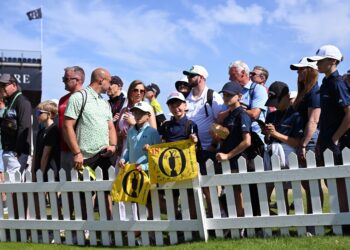
A good yardage book is like a comfort blanket in a professional tournament. Whether it’s when a player and a caddie are at their ball, or if they’re unsure and reassessing a shot, out comes the book.
The yardage books for Royal Birkdale this week are produced by the renowned Strokesaver and they’re an incredible resource of information about the golf course.

One of the really cool things about The Open is that you can buy them on site in the shop. And not some abridged, toned down, Birkdale-lite version either.
Hand over your tenner and you’ll have in your hands the Players’ Edition being toted around the Southport links by the competitors.
But it’s one thing to buy the book, it’s another to understand what your eyes are seeing. At first glance, it looks like a mass of numbers and lines and arrows.
Once you understand the system, though, it’s quite straightforward. Here’s how to decipher the yardage book and start reading holes like a pro when you’re out on the course.
How do golfers read a yardage book?
First up, are you a yards or metres person? This is because there are two versions of the book depending on whether you favour the Imperial or Metric system.
Each hole is spread over two pages. You’ll instinctively be drawn to the second of those and the image at the bottom. This shows the views the players see from the tee and marks out yardages to landmarks – such as the edge of a bunker and specific sprinkler heads.
Above that is the layout of the hole and a host of numbers we’ll uncover in a moment. On the other page is a view of the green and its various contours.
You’ll notice it’s much more spartan. There are a couple of reasons for this. Caddies like to take notes – detailing yardages they may have played from during certain rounds, or showing wind directions, and this is a place to scribble.
Green reading materials are also prohibited at The Open, with players only able to use approved yardage books. The idea is that players use their skill to work out the line of a putt.
So while they can add some general slope directions into the squares that make out the green – and each square represents five yards – there are limits over what they can input.
The green chart uses two shades of arrows to indicate the severity of slopes. The darker arrows denote slopes of five degrees or more, while lighter arrows show slopes of more than six degrees.
You’ll often see these around the edges of greens, highlighting raised surfaces and run-off areas.
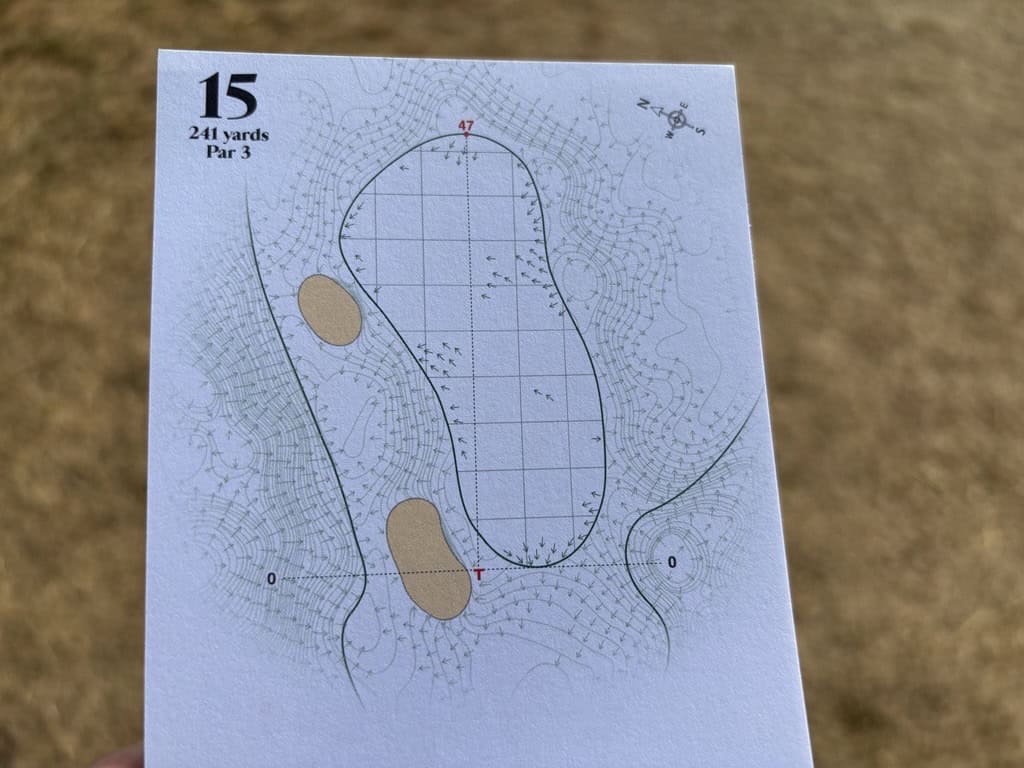
What is the red T on a golf green?
Strokesaver say the red “T” at the front of a green is the “measure point on the intended playing line bisecting the green at or at level with the front of green”. I’ve also seen it used as a measuring point for hole locations and calculating distances to the putting surface.
It’s also used as a starting point to measure the length of a green with the final yardage posted at the back. The longest green at Royal Birkdale this week is the new par 3 15th, which measures 47 yards from front to back.
How are yardage books used at The Open?
The hole-by-hole layouts may look they feature a bewildering array of numbers but they’re relatively easy to fathom when you understand their purpose.
The red digits indicate the distance from the back tee along the intended line of play. The black numbers show the distance to the ‘T’ at the front of the green.
The numbers that are circled are the distances to that front marker from the various sprinkler heads dotted around the hole.
Letters identify notable run out reference points, while numbers indicate carry distances to hazards or course features.
And there you have it. Detail is everything and with this knowledge to hand, hopefully you no longer feel like you need a maths degree to work out the yardage book.
Now have your say
What do you make of this Open yardage book explainer? Has it helped you decode the book? Do you often use yardage books during your rounds? Let me know in the comments or get in touch on X.